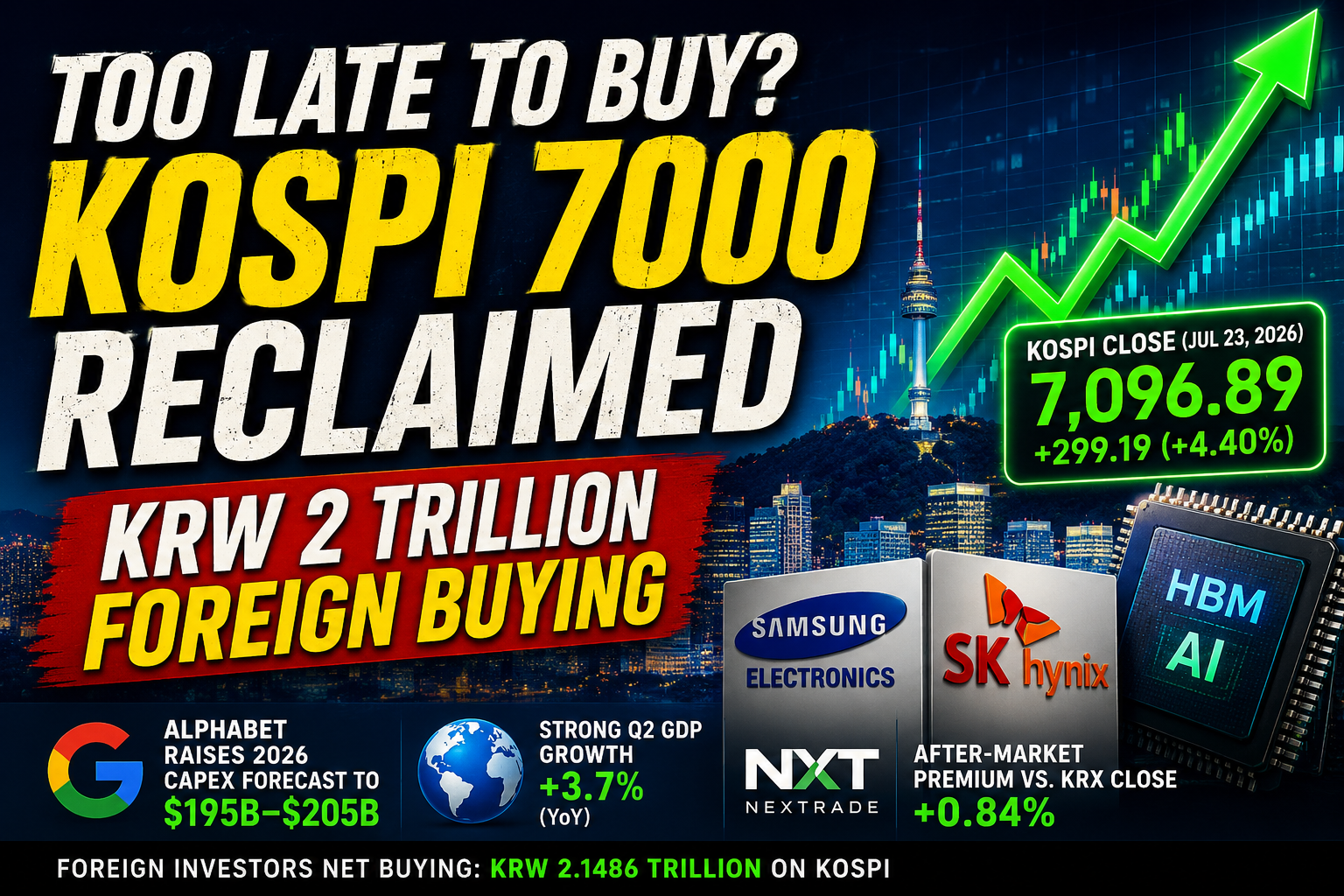
KOSPI 7000 has become a reality again. On July 23, 2026, the KOSPI gained 299.19 points, or 4.40%, to close at 7,096.89, reclaiming the 7,000 level for the first time in five trading sessions.
The KOSDAQ also rose 5.22% to 790.28, while foreign investors purchased a net KRW 2.1486 trillion worth of shares on the main KOSPI market. After the regular session ended, major semiconductor stocks including Samsung Electronics and SK hynix continued to trade above their KRX closing prices on the NXT after-market.
Only a few days earlier, fears of another market collapse had dominated investor sentiment. The atmosphere has now changed completely.
“Is the sell-off really over?”
“Should investors buy Samsung Electronics and SK hynix now?”
“Will waiting for another correction mean missing the rally again?”
The rally was supported by identifiable catalysts and cannot be dismissed as a purely technical bounce. However, chasing the market based solely on fear of missing out could also be dangerous after the index gained more than 4% in one session.
Key Takeaways
- The KOSPI rose 4.40% to 7,096.89 on July 23, 2026, reclaiming the 7,000 level.
- Foreign investors purchased a net KRW 2.1486 trillion in KOSPI stocks but sold a net KRW 657 billion in KOSPI 200 futures.
- Approximately 77.6% of foreign net buying was concentrated in Samsung Electronics and SK hynix.
- Alphabet raised its 2026 capital expenditure forecast to between USD 195 billion and USD 205 billion.
- The NXT after-market finished 0.84% above the KRX closing-price benchmark on a market-capitalization basis.
- For the rebound to develop into a sustained uptrend, the KOSPI must hold above 7,000 and foreign buying must continue.
KOSPI 7000 Reclaimed: What Happened in the Market?
The KOSPI opened 165.65 points higher at 6,963.35 and continued to extend its gains throughout the session. The index reached an intraday high of 7,108.44 before closing near the high at 7,096.89.
Foreign investors led the buying.
| Investor Group | Net KOSPI Purchases or Sales |
|---|---|
| Foreign investors | KRW 2.1486 trillion net purchase |
| Institutional investors | KRW 98.6 billion net purchase |
| Individual investors | KRW 2.2089 trillion net sale |
| Foreign investors in KOSPI 200 futures | KRW 657 billion net sale |
Foreign investors recorded their fourth consecutive session of net buying in the KOSPI market. They absorbed most of the shares sold by individual investors, whose net selling exceeded KRW 2 trillion.
However, the divergence between the cash and futures markets deserves attention. Foreign investors purchased large amounts of cash equities while selling KOSPI 200 futures.
This suggests that overseas investors may not have made an unhedged bet on a broad Korean market rally. They may instead have purchased selected large semiconductor stocks while using futures positions to partially hedge market risk.
Why Foreign Investors Bought KRW 2 Trillion: Alphabet Expands AI Investment
The strongest catalyst behind the KOSPI rally was the earnings report and investment plan announced by Alphabet, the parent company of Google.
Alphabet reported second-quarter 2026 revenue of USD 119.8 billion, representing year-over-year growth of 24%. Google Cloud revenue increased 82% to USD 24.8 billion, demonstrating that demand for AI infrastructure and enterprise AI services remained strong.
The most important development for Korean semiconductor stocks was Alphabet’s capital expenditure plan.
Alphabet raised its 2026 capital expenditure forecast from a previous range of USD 180 billion to USD 190 billion to a new range of USD 195 billion to USD 205 billion. Both the lower and upper ends of the forecast were increased by USD 15 billion.
Not all of Alphabet’s capital spending will translate directly into semiconductor revenue because the budget also includes data-center buildings, electricity infrastructure and networking equipment. Nevertheless, the company has made it clear that it will continue expanding servers, data centers and network capacity to address shortages in AI computing infrastructure.
This can be interpreted as a positive signal for Korean companies supplying high-bandwidth memory, server DRAM, enterprise solid-state drives, AI-server multilayer ceramic capacitors and advanced semiconductor substrates.
Investors had previously become concerned that growth in hyperscaler AI spending was approaching a peak. Alphabet’s higher capital expenditure forecast has reduced those concerns, at least in the near term.
South Korea’s Second-Quarter GDP Beat Expectations
South Korea’s stronger-than-expected economic growth figures also improved investor sentiment.
According to the Bank of Korea, real gross domestic product increased 0.6% from the previous quarter and 3.7% from a year earlier in the second quarter of 2026. Real gross domestic income increased 3.6% quarter over quarter and 15.6% year over year.
The Korean economy has continued to grow despite weak domestic demand and elevated interest-rate pressure, supported primarily by semiconductor exports.
The resilient GDP figures gave foreign investors a macroeconomic justification for increasing their exposure to Korean equities. Alphabet’s expanded AI investment plan and expectations for semiconductor-led Korean export growth emerged at the same time, accelerating the inflow of foreign capital into large semiconductor stocks.
Samsung Electronics and SK hynix Accounted for 77.6% of Foreign Buying
Although the overall KOSPI rose sharply, foreign capital was not distributed evenly across the market.
Foreign investors purchased a net KRW 1.3159 trillion of SK hynix and KRW 350.4 billion of Samsung Electronics. Combined net purchases of the two stocks reached KRW 1.6663 trillion.
This represented approximately 77.6% of the total KRW 2.1486 trillion in foreign net purchases on the KOSPI.
| Company | KRX Closing Price | Daily Change | Foreign Net Purchase |
|---|---|---|---|
| Samsung Electronics | KRW 270,000 | +3.65% | KRW 350.4 billion |
| SK hynix | KRW 1,919,000 | +4.86% | KRW 1.3159 trillion |
| Samsung Electro-Mechanics | KRW 1,448,000 | +7.66% | Not disclosed |
Samsung Electronics closed at KRW 270,000, while SK hynix finished at KRW 1,919,000. Samsung Electro-Mechanics surged 7.66%, supported by reports concerning an AI-server MLCC supply agreement with a major global company.
Rather than describing the session as a broad revaluation of all Korean equities, it would be more accurate to characterize it as a foreign-investor-driven rally concentrated in large semiconductor stocks following confirmation of continued global AI investment.
For a detailed analysis of Samsung Electronics’ earnings, HBM and foundry outlook, see our Samsung Electronics Stock Outlook 2026.
For more on SK hynix’s HBM4 shipments and competitive position, see our SK hynix Stock Outlook 2026.
For an analysis of AI-server MLCC and FCBGA growth opportunities, see our Samsung Electro-Mechanics Stock Outlook 2026.
Semiconductor Stocks Continued to Rise in the NXT After-Market
Buying momentum did not disappear after the regular session ended.
According to market information published by Nextrade at 8:05 p.m. on July 23, 2026, the market-capitalization-weighted change for NXT after-market stocks was 5.31% above the reference price.
The same group of stocks was also 0.84% above the KRX closing-price benchmark.
- Number of NXT after-market stocks traded: 606
- After-market trading volume: 26,773,595 shares
- After-market trading value: approximately KRW 4.1946 trillion
- Market-capitalization change versus reference prices: +5.31%
- Market-capitalization change versus KRX closing prices: +0.84%
| Company | KRX Closing Price | NXT Displayed Price | Change Versus Reference Price | Premium Versus KRX Close |
|---|---|---|---|---|
| Samsung Electronics | KRW 270,000 | KRW 273,000 | +4.80% | Approximately +1.11% |
| SK hynix | KRW 1,919,000 | KRW 1,947,000 | +6.39% | Approximately +1.46% |
| Samsung Electro-Mechanics | KRW 1,448,000 | KRW 1,473,000 | +9.52% | Approximately +1.73% |
All three stocks were displayed above their KRX closing prices on NXT. This indicates that additional demand for large semiconductor stocks remained after the regular market’s sharp rally.
The individual-stock listings on the official NXT website are displayed with a 20-minute delay. The figures above therefore reflect the values shown on the website at 8:05 p.m.
A premium in the NXT after-market does not guarantee a higher KRX opening price during the next regular session. If U.S. technology shares weaken overnight or foreign investors begin taking profits, the NXT premium could quickly disappear after the next market opens.
Is It Really Too Late to Buy?
When the KOSPI rises 4.40% in one session and semiconductor stocks continue climbing on NXT, investors may feel that they will miss the opportunity unless they buy immediately.
However, a sharp one-day gain can be both evidence of improving momentum and a reason to expect near-term profit-taking.
The current market is being driven heavily by a small number of large-cap companies, including Samsung Electronics and SK hynix. Investors should not assume that the entire Korean market has entered a stable uptrend based only on the headline index.
New investors should monitor three main conditions.
1. Can the KOSPI Hold Above 7,000 on a Closing Basis?
The first benchmark is the 7,000 level.
Temporarily trading above 7,000 during the session is less important than whether the index can continue closing above that level after a correction.
If the KOSPI maintains strong trading value above 7,000 and breaks above the July 23 intraday high of 7,108, the rebound would have a greater chance of developing beyond short covering into a sustained uptrend.
If the index quickly falls back below 7,000 and then drops below 6,800, investors would need to reconsider whether the rally was mainly a technical rebound following an excessive decline.
2. Will Foreign Cash and Futures Positions Move in the Same Direction?
Foreign investors bought more than KRW 2 trillion in cash equities but sold KOSPI 200 futures.
A more stable uptrend would require foreign cash-market buying to continue while selling pressure in the futures market declines.
Investors should therefore monitor not only foreign net purchases of cash equities but also KOSPI 200 futures, the won-dollar exchange rate and program-trading flows.
3. Will Buying Spread Beyond Semiconductors?
Samsung Electronics and SK hynix can push the KOSPI sharply higher on their own, but such a rally would have a narrow foundation.
For the 7,000 level to become a more stable support zone, improving earnings expectations and trading activity must spread to automobiles, financials, shipbuilding, nuclear power, biotechnology, rechargeable batteries and small- and mid-cap companies.
If the entire index falls sharply as soon as semiconductor stocks stop rising, it would indicate that the market’s internal strength has not fully recovered.
Short-Term KOSPI Scenarios
Bullish Scenario
In the bullish scenario, the KOSPI holds above 7,000 and foreign investors continue purchasing Samsung Electronics and SK hynix.
If the index breaks above 7,108 with higher trading value and additional U.S. hyperscalers announce expanded AI investment plans, the semiconductor-led rally could strengthen further.
Market attention could then shift toward the recovery of the 7,200 range and whether buying expands into industries outside semiconductors.
Neutral Scenario
In the neutral scenario, the KOSPI fluctuates between approximately 6,800 and 7,100 while digesting the sharp one-day gain.
Even if profit-taking pushes the index lower, a correction would not necessarily be negative if the KOSPI remains above 6,800, trading value stays elevated and foreign investors do not switch to aggressive net selling.
A period of consolidation after a sharp rally could reduce short-term overheating and allow new buyers to enter the market.
Bearish Scenario
In the bearish scenario, foreign investors return to net selling and the KOSPI drops below 6,800.
This would increase the likelihood that the move above 7,000 was driven mainly by short covering and a technical rebound rather than the beginning of a new uptrend.
Foreign flows could also deteriorate if U.S. technology stocks fall despite Alphabet’s higher investment plan or if the won-dollar exchange rate rises sharply.
New Investors Should Seek Confirmation Rather Than Chase the Rally
Investing a large amount immediately after a one-day surge because of fears that it may already be too late is a high-risk strategy.
Investors considering a new position may find it more reasonable to evaluate the market in the following order.
- Confirm whether the KOSPI can remain above 7,000 after a correction.
- Check whether foreign buying of Samsung Electronics and SK hynix continues during the next trading session.
- Determine whether the premium formed on NXT remains during the next KRX regular session.
- Monitor whether trading activity spreads beyond semiconductor stocks.
- Use staged purchases to manage unusually high short-term volatility.
Investors who already hold semiconductor stocks should avoid making an all-or-nothing decision based on a single day’s price movement. Foreign flows and global AI investment plans remain more important than short-term fluctuations.
For the key indicators investors should monitor when analyzing global AI investment and semiconductor companies, see our AI Semiconductor Investment Guide 2026.
Conditions That Would Weaken the Bullish Interpretation
The significance of the KOSPI 7000 breakout should be reassessed if several of the following signals appear at the same time.
- Foreign investors return to aggressive net selling in the KOSPI cash market.
- Samsung Electronics and SK hynix surrender their entire NXT premiums.
- The KOSPI falls below 6,800 only a few days after recovering 7,000.
- Major U.S. technology companies repeatedly lower their AI capital expenditure forecasts.
- Forecasts for both HBM and server-memory prices deteriorate.
- A sharp increase in the won-dollar exchange rate raises foreign-exchange-loss concerns.
- Only semiconductor stocks rise while earnings expectations for other industries continue to weaken.
A change in one indicator alone would not necessarily mean the uptrend has ended. Investors should determine whether foreign flows, semiconductor earnings expectations, the exchange rate and global AI investment are weakening simultaneously.
Conclusion: The Market Has Signaled That the Sell-Off May Be Ending, but the Uptrend Is Not Yet Confirmed
The KOSPI 7000 recovery was not a meaningless rebound.
Alphabet expanded its AI investment plan, South Korea reported stronger-than-expected economic growth and foreign investors purchased more than KRW 2 trillion in KOSPI stocks. Samsung Electronics, SK hynix and Samsung Electro-Mechanics also remained above their KRX closing prices on NXT.
However, foreign buying was heavily concentrated in Samsung Electronics and SK hynix, while overseas investors remained net sellers in the KOSPI 200 futures market. Overall market volatility also remains exceptionally high.
The answer to the headline question, “Is it too late to buy?”, is therefore as follows.
It cannot be concluded that investors must buy immediately or risk missing the market. However, if foreign buying continues and the KOSPI holds above 7,000, this rebound could become a stronger trend-reversal signal rather than a temporary technical recovery.
Rather than chasing the market because of fear of missing out, investors should first confirm that the KOSPI can establish support above 7,000, that foreign cash and futures flows improve, and that the rally expands beyond the semiconductor sector.
Sources
- Yonhap News Agency, KOSPI closing report for July 23, 2026
- Industry News, foreign, institutional and retail flows and KOSPI 200 futures
- The Korea Herald Business, foreign purchases of Samsung Electronics and SK hynix
- Bank of Korea, advance estimate of second-quarter 2026 real GDP
- Google, Alphabet second-quarter 2026 earnings announcement
- Reuters, Alphabet raises its 2026 capital expenditure forecast
- Nextrade, NXT market information for July 23, 2026
This article is provided for informational purposes and is based on publicly available market data. It does not constitute a recommendation to buy or sell any security. Market projections and scenarios may differ from actual outcomes, and all investment decisions and their results remain the responsibility of the investor.