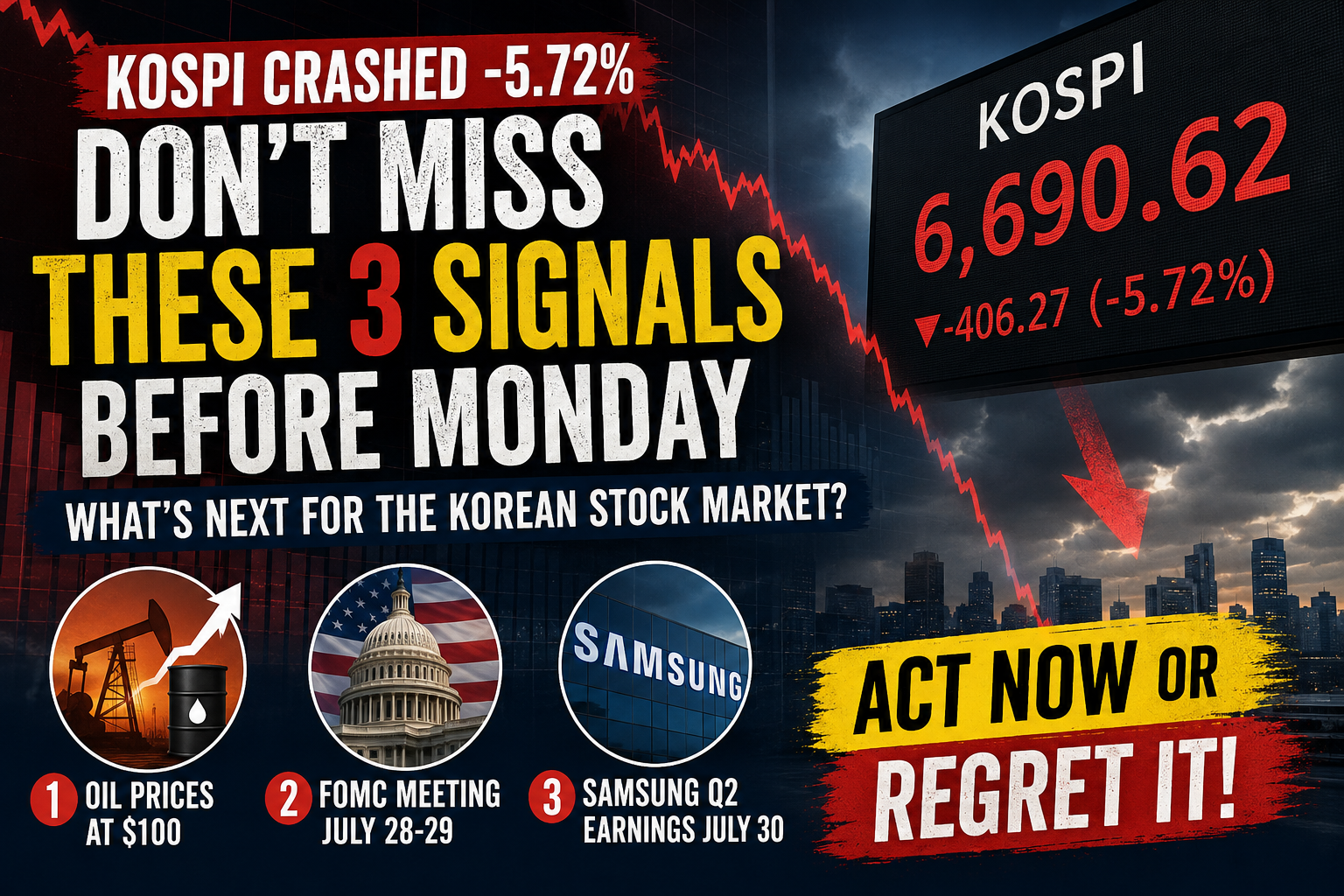
KOSPI crash explained: investors who dismiss Friday’s plunge as nothing more than a temporary reaction to Middle East tensions could be caught off guard when the Korean market reopens on Monday.
On July 24, 2026, the KOSPI fell 406.27 points, or 5.72%, to close at 6,690.62. The index surrendered the psychologically important 7,000 level only one day after recovering it. The KOSDAQ also dropped 5.32% to 748.22.
Samsung Electronics fell 7.59%, while SK hynix declined 8.34%. Sell-side program trading curbs were triggered in both the KOSPI and KOSDAQ markets as institutional and foreign selling accelerated.
Foreign and institutional investors sold a combined KRW 5.23 trillion in the main KOSPI market. Individual investors absorbed nearly all of that pressure by purchasing approximately KRW 5.18 trillion.
The conclusion investors should not ignore
Friday’s crash was not caused by oil prices alone. It was the result of several risks hitting the market simultaneously: Middle East tensions, rising oil prices, higher U.S. Treasury yields, a stronger dollar, aggressive foreign selling, and concerns that semiconductor expectations had become excessive.
NXT after-hours trading later recovered 0.83% from the official KRX closing level. This suggests that panic did not intensify after the regular session ended. However, it does not yet confirm that the market has reached a bottom.
KOSPI Crash Explained: Key Market Numbers
| Market Indicator | July 24 Result |
|---|---|
| KOSPI Close | 6,690.62 |
| KOSPI Change | -5.72% |
| KOSPI Intraday Low | 6,650.41 |
| KOSDAQ Close | 748.22 |
| KOSDAQ Change | -5.32% |
| Foreign Investor Flow | Approximately KRW 3.28 trillion net selling |
| Institutional Investor Flow | Approximately KRW 1.95 trillion net selling |
| Individual Investor Flow | Approximately KRW 5.18 trillion net buying |
| USD/KRW Exchange Rate | KRW 1,466.6 per U.S. dollar |
The most important figure is not the size of the decline itself. It is the direction of institutional and foreign capital.
Retail investors purchased more than KRW 5 trillion in Korean shares, but both foreign and institutional investors sold aggressively. A technical rebound may occur after such a severe decline, but any recovery could remain fragile unless foreign investors return to the market.
Reason 1: Oil Above $100 Increased Korea’s Economic Risk
The most immediate trigger was the surge in international oil prices.
Concerns surrounding military conflict between the United States and Iran intensified, while investors also focused on potential disruption to strategic shipping routes, including the Strait of Hormuz and the Bab el-Mandeb Strait.
Brent crude moved above $100 per barrel, creating a particularly serious problem for South Korea because the country depends heavily on imported oil and natural gas.
- Higher transportation and manufacturing costs
- Renewed inflation pressure
- Greater risk of additional Bank of Korea tightening
- Pressure on Korea’s trade balance
- A weaker Korean won
- Reduced foreign appetite for Korean equities
If oil prices stabilize quickly, part of Friday’s decline could be recovered. However, if military tensions worsen over the weekend or Brent crude continues rising, the KOSPI could open sharply lower again on Monday.
Investors who wait until the Korean market opens to check oil prices may already be reacting after the market has moved.
Reason 2: The Oil Shock Spread to U.S. Interest Rates
Higher oil prices do more than increase energy costs. They also raise concerns that inflation could remain elevated for longer.
The U.S. 10-year Treasury yield climbed toward 4.70%, while the U.S. Dollar Index moved above 101. The combination of high oil prices, rising bond yields, and a stronger dollar is generally negative for export-focused markets such as South Korea.
Higher interest rates increase the discount rate applied to future corporate earnings. This puts greater valuation pressure on stocks whose prices already reflect strong long-term growth expectations.
Artificial intelligence, semiconductor, robotics, and other high-growth sectors may therefore experience larger price swings than defensive sectors.
The Federal Reserve is scheduled to hold its next FOMC meeting on July 28 and 29.
The market will focus not only on the interest-rate decision, but also on how Federal Reserve officials describe the inflationary impact of rising oil prices.
- Will the Fed describe the oil shock as temporary?
- Will officials emphasize renewed inflation risks?
- Will the Fed leave the door open to further tightening?
- Will policymakers signal that rates must remain higher for longer?
If the Fed delivers a more hawkish message, U.S. yields and the dollar could rise further. That would make a sustained KOSPI recovery more difficult.
Reason 3: Foreign Investors Sold Samsung Electronics and SK hynix
Samsung Electronics and SK hynix represent an exceptionally large portion of the KOSPI’s total market capitalization. When both companies decline sharply at the same time, the broader index has little chance of remaining stable.
Samsung Electronics closed at KRW 249,500, down 7.59%. SK hynix fell 8.34% to KRW 1,759,000. Samsung Electro-Mechanics declined 8.43%, while SK Square dropped 9.17%.
Concerns over the sustainability of AI infrastructure spending combined with fears that the memory semiconductor cycle may be approaching a peak.
The semiconductor industry’s earnings outlook did not collapse in a single day. What changed was the price investors were willing to pay for future growth.
Semiconductor valuations already reflected strong expectations. Even solid earnings may not be enough to support stock prices if management guidance falls short of what the market has already priced in.
Samsung Electronics is scheduled to release its full second-quarter 2026 earnings and hold a conference call on July 30 at 10:00 a.m. Korea Standard Time.
Investors should focus on the following issues rather than the headline operating-profit figure alone:
- Progress in HBM4 and HBM4E customer qualification
- Memory average selling prices
- Management’s outlook for second-half memory demand
- Foundry profitability and 2-nanometer production
- Capital expenditure plans
- Management’s assessment of global AI infrastructure demand
If Samsung’s guidance reduces fears of a semiconductor-cycle peak, the earnings call could become a catalyst for a broader market rebound.
If management provides a cautious second-half outlook, however, volatility could increase again even if reported earnings remain strong.
Why Did NXT Trading Recover After the KRX Close?
The regular KRX session ended in panic, but Korean shares recovered modestly during the NXT after-hours session.
The NXT market remained down 5.03% compared with the previous reference price, but it closed 0.83% above the official KRX closing level on a market-capitalization basis.
| NXT Market Indicator | Result |
|---|---|
| Change From Reference Price | -5.03% |
| Change From KRX Closing Level | +0.83% |
| Number of Traded Stocks | 604 |
| Trading Volume | 17,241,686 shares |
| Trading Value | Approximately KRW 2.91 trillion |
Major semiconductor stocks also closed above their official KRX closing prices.
| Company | KRX Close | NXT Close | Premium to KRX | NXT Daily Change | NXT Total Volume |
|---|---|---|---|---|---|
| Samsung Electronics | KRW 249,500 | KRW 252,500 | +1.20% | -6.48% | 15,050,727 shares |
| SK hynix | KRW 1,759,000 | KRW 1,781,000 | +1.25% | -7.19% | 2,978,737 shares |
| Samsung Electro-Mechanics | KRW 1,326,000 | KRW 1,347,000 | +1.58% | -6.98% | 447,226 shares |
Individual-stock NXT volume represents the combined volume displayed for the pre-market, main-market, and after-hours sessions.
The rebound suggests that some investors viewed Friday’s official closing prices as excessively depressed and began buying after the regular market closed.
However, Samsung Electronics and SK hynix were still down more than 6% and 7%, respectively, compared with the previous reference price.
The NXT recovery should be interpreted as a reduction in panic, not confirmation of a new bullish trend.
Should Investors Sell on Monday?
Selling emotionally at Monday’s opening price could expose investors to a gap-down reversal and extreme intraday volatility.
Buying aggressively simply because NXT recovered is equally dangerous. Any escalation in Middle East tensions over the weekend could make Friday’s after-hours prices irrelevant.
The following KOSPI levels deserve close attention:
- 6,650: Friday’s intraday low and the first immediate support level
- 6,450–6,500: A major support area created by previous July lows
- 6,800: The first level the index must recover to reduce short-term selling pressure
- 7,000: A major psychological level that recently failed
- 7,200: A stronger confirmation level for a broader trend recovery
For additional technical context, read our previous analysis: KOSPI Holds 6,500 but Fails to Rebound: What Investors Must Watch Next.
Three Scenarios for the Week Ahead
Bullish Scenario: Oil Stabilizes and Foreign Investors Return
This scenario becomes more likely if Middle East tensions ease and Brent crude falls back below $100.
If Samsung Electronics and SK hynix open above their NXT closing prices and foreign investors begin purchasing both cash equities and index futures, the KOSPI could recover 6,800 and retest 7,000.
A brief move above 7,000 would not be enough. Investors should look for the index to hold above that level into the closing auction.
Base Scenario: Extreme Volatility Between 6,450 and 7,000
Oil prices may remain elevated without rising significantly further, while investors wait for the FOMC decision and Samsung Electronics earnings.
Under this scenario, bargain buying and continued foreign selling could produce daily market swings of 3% to 5%.
This remains the most reasonable scenario until the market provides clearer evidence of either a breakdown or a sustained recovery.
Bearish Scenario: Oil Rises Again and 6,450 Fails
This scenario becomes more likely if the Middle East conflict intensifies, Brent crude continues to rise, and the U.S. 10-year Treasury yield remains above 4.70%.
If foreign investors continue selling trillions of won and Samsung Electronics and SK hynix fall below Friday’s lows, the KOSPI may test the 6,450–6,500 support zone.
A high-volume closing break below 6,450 would suggest that investors should prioritize additional downside risk over expectations of a short-term technical rebound.
Three Signals Investors Must Check Before Monday
1. Oil Prices and Middle East Developments
Watch whether Brent crude remains above $100 and whether major oil shipping routes face disruption.
If oil prices do not stabilize, inflation, bond yields, and currency pressure are unlikely to improve.
2. The July 28–29 FOMC Meeting
The key issue is not only whether the Fed changes interest rates. Investors must evaluate how strongly policymakers emphasize inflation risks caused by higher energy prices.
A hawkish message could increase the valuation pressure on Korean technology and growth stocks.
3. Samsung Electronics Earnings on July 30
The most important signals will come from HBM production, memory pricing, foundry profitability, capital spending, and second-half guidance.
A meaningful change in Samsung’s outlook could quickly affect SK hynix, Samsung Electro-Mechanics, and the entire Korean semiconductor sector.
For our broader market outlook, read KOSPI Outlook for the Second Half of 2026: Can the Index Reach 10,000?.
What Existing Shareholders and New Buyers Should Do
The same strategy is not appropriate for every investor.
- Long-term investors with sufficient cash: Focus on whether oil prices, foreign flows, and corporate earnings indicate a structural deterioration rather than reacting to a single session.
- Leveraged investors: Manage liquidation and margin-call risk before attempting to predict a rebound.
- Investors waiting to buy: Avoid committing all available capital based only on the NXT recovery. Consider gradual entries after confirming support levels and foreign-investor flows.
- Short-term traders: Monitor whether 6,650 holds and whether Samsung Electronics and SK hynix strengthen or weaken after the opening auction.
In a market moving more than 5% in a single day, position sizing matters more than accurately predicting every short-term move.
Conclusion: The Panic Eased, but the Bottom Is Not Confirmed
The July 24 KOSPI crash was caused by a combination of Middle East risk, oil prices above $100, rising U.S. interest rates, aggressive foreign selling, and concerns surrounding semiconductor valuations.
Foreign and institutional investors sold more than KRW 5 trillion in the main market, while Samsung Electronics and SK hynix fell between 7% and 8%.
This was not an ordinary decline in a small group of companies. It was a broad risk-off event that affected the entire Korean equity market.
NXT trading later recovered 0.83% from the official KRX closing level. Samsung Electronics and SK hynix also finished approximately 1% above their regular-session closing prices.
That recovery shows that buyers returned near Friday’s lows, but it does not prove that the correction is over.
The market’s next direction will depend on three signals:
- Oil prices and any escalation in the Middle East
- The Federal Reserve’s July 28–29 inflation and interest-rate message
- Samsung Electronics earnings and semiconductor guidance on July 30
Investors who wait until Monday’s opening bell to review these developments may be reacting only after the market has already repriced them.
This is not the time to sell everything in panic or buy aggressively based on one after-hours rebound.
Watch the 6,450–6,500 support zone, a recovery above 6,800, foreign-investor flows, and the direction of Samsung Electronics and SK hynix before making a major decision.
Sources
- Yonhap News Agency: July 24 KOSPI close and market conditions
- Newsis: Investor flows and major stock movements
- Nextrade: NXT market and individual-stock trading data
- Federal Reserve: 2026 FOMC calendar
- Samsung Electronics Investor Relations
AI Use and Investment Risk Disclosure
This article uses artificial intelligence to collect, compare, and analyze publicly available market data, corporate investor-relations materials, exchange information, and media reports.
Individual-stock NXT volume refers to the combined pre-market, main-market, and after-hours volume displayed by Nextrade. Premiums to the KRX closing price were calculated using each market’s published closing prices.
Market scenarios and technical price levels do not guarantee future returns. Oil prices, exchange rates, interest rates, and geopolitical conditions can change rapidly.
Investors should confirm the latest information through the Korea Exchange, Nextrade, corporate disclosures, and their securities provider before making an investment decision.
This article is provided for informational purposes only and does not constitute a recommendation to buy, sell, or hold any financial product. All investment decisions and resulting gains or losses remain the responsibility of the investor.